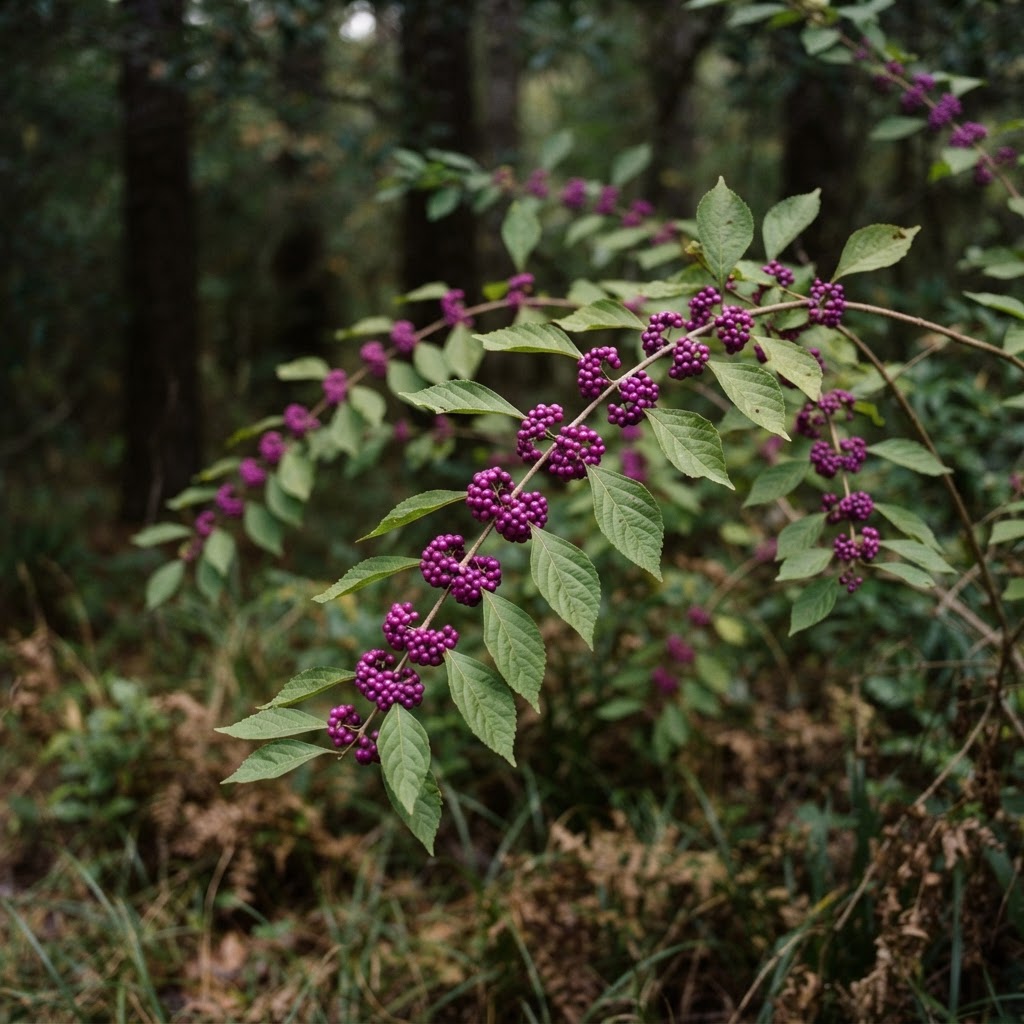
The beautyberry is a plain, open shrub that grows along the wood edges and the old field margins, unremarkable through the spring and early summer. Then in the late summer it puts out tight clusters of brilliant, almost impossible purple berries along the stems at the leaf joints, so bright that a man who has never seen one will stop and look. The deer find them early. The leaves, crushed, carry a sharp green scent that the old people along the coast used to keep the mosquitoes off, long before anyone knew the name of the compound that does it. It is a plant that does its showy work late and all at once.
1Cultural and Historical Significance
Native to the American Southeast from the Gulf states up into the mid-Atlantic, the American Beautyberry (Callicarpa americana) is a plain, open shrub of the wood edges and old field margins, unremarkable through the spring and early summer — and then, in late summer, suddenly hung with tight clusters of brilliant, almost impossible purple berries along the stems at the leaf joints, so bright that a person who has never seen one will stop and look. Indigenous nations of the Gulf used the leaves and roots in traditional practice for skin complaints, fevers, and — most enduringly — as a mosquito and insect repellent, crushing the leaves and rubbing them on the skin, a use later validated by USDA research. Evolving in competitive, disturbed edge habitat, C. americana developed a chemistry of clerodane diterpenes, callicarpenal, and intermedeol that defends its foliage against insect herbivory, alongside calliterpenone and berry anthocyanins.
Botanical Sexuality
Beautyberry is monoecious, bearing both male and female parts in the same small pinkish flowers. The flowers are inconspicuous, but the fruit that follows is unmistakable.
Reproductive Features
Small, pale pink to lavender flowers appear in clusters along the stems at the leaf axils in early summer. Fertilized flowers develop into the signature tight clusters of glossy, brilliant magenta-purple drupes that encircle the stem at each leaf joint in late summer and autumn.
Foliage Identification
Leaves are opposite, simple, oval, four to eight inches long, with coarsely serrated margins and a pointed tip; the upper surface is medium green, the underside paler and softly hairy. The stems are slender and arching, and the shrub grows in loose, open clumps three to five feet tall. Crushed leaves release a sharp, green, slightly resinous scent.
Harvesting Implications & Foliar Potency
Late-summer leaves carry the peak concentration of the insect-repellent compounds callicarpenal and intermedeol — the primary resource for transcutaneous insect defense. Autumn roots and berries hold the clerodane diterpenes and anthocyanins that carry the plant's oncolytic and antioxidant weight.
2Chemical Composition and Bioactive Constituents
American Beautyberry holds a distinctive clerodane-diterpene chemistry: callicarpenal and intermedeol in the leaves, and clerodane diterpenes plus calliterpenone in the roots, alongside anthocyanin pigments in the berries. The leaf compounds repel biting insects by disrupting their olfactory sensing of host cues, while the root diterpenes carry the plant's pro-apoptotic weight.
3Mechanisms of Action and Systemic Physiological Effects
A. Neurological and Central Nervous System Effects
The berry anthocyanins and leaf phenolics offer modest central antioxidant support and dampen peripheral nerve excitability, contributing to the plant's traditional analgesic reputation — though beautyberry is not a primary neurological botanical.
B. Systemic Physiological Effects
Systemically, the root clerodane diterpenes show pro-apoptotic activity against melanoma and pancreatic cell lines in laboratory studies. Calliterpenone moderates inflammatory cytokine signaling, and the leaf monoterpenes pass into cutaneous lipids, creating a subtle transcutaneous vapor that masks human scent from biting arthropods.
C. Extraction and Preparation Profiles
Cold Extraction
(Spring Sap / Cold Maceration)
What Is Gained
Cold maceration of crushed leaves draws off water-soluble phenolics, trace intermedeol, and a fraction of the anthocyanin pigments into a light, faintly green, resinous liquor. Unheated, it preserves a measure of the insect-repellent monoterpenes for gentle transcutaneous use and mild antioxidant support.
What Is Lost
The bulk of the lipophilic callicarpenal, clerodane diterpenes, and volatile monoterpenes remain locked in the leaf and root oils. Cold extraction forfeits the full insect-repellent reach and the oncolytic clerodane-diterpene pathways.
What Happens to You
Decoction
(Boiling / Heat Maceration)
What Is Gained
Boiling leaves or roots ruptures the tissue, liberating a portion of the clerodane diterpenes, calliterpenone, and water-dispersible tannins into a warm, resinous, astringent decoction. Heat releases aromatic monoterpenes as vapor that, inhaled, supports respiratory mucosa, while the warm liquid tones digestive tissue.
What Is Lost
Prolonged boiling drives off the volatile, insect-repellent monoterpenes as steam and only partially dissolves the strongly lipophilic clerodane diterpenes. Decoction therefore forfeits peak oncolytic diterpene extraction and the transcutaneous insect-defense fraction.
What Happens to You
Fermentation with Wild Yeast
(Spontaneous Viticulture & Ethanol Extraction)
What Is Gained
Fermenting crushed leaves, roots, or berry extracts with wild yeasts generates ethanol, which dissolves the non-polar callicarpenal, clerodane diterpenes, and lipophilic terpene fractions that water cannot reach. Microbial enzymes cleave glycosidic bonds, freeing maximally bioavailable diterpene and anthocyanin aglycones that cross the blood-brain barrier to engage the plant's defining oncolytic signaling.
Cancer Destruction & Oncolytic Powers
Extracted via amphiphilic alcoholic fermentation, clerodane diterpenes and calliterpenone act as multi-targeted agents against malignant cell lines, especially melanoma and pancreatic lines. They induce cell-cycle arrest by downregulating Cyclin D1 and CDK4, shift the Bax/Bcl-2 balance toward intrinsic apoptosis via caspase-9 and caspase-3, inhibit VEGF and matrix metalloproteinases to suppress angiogenesis and metastasis, and suppress NF-κB to strip away the pro-inflammatory cytokine microenvironment (TNF-α, IL-6) tumors exploit.
What Is Lost
Yeast metabolism consumes berry sugars into ethanol and carbon dioxide, eliminating the bright fruity sweetness. The fermented liquor is dry, bitter, and resinous, forfeiting the gentle berry palate and the volatile insect-repellent top-notes.
What Happens to You
4Safety, Toxicology, and Precautions
Root Diterpenes in Excess
Concentrated root preparations carry potent clerodane diterpenes that, in excess, can irritate the gastric mucosa and stress the liver. Keep root-derived extracts moderate and occasional.
Berry Seeds
The berries are edible in moderation but the small seeds are hard and indigestible; large quantities of crude berries can cause mild gastrointestinal discomfort.