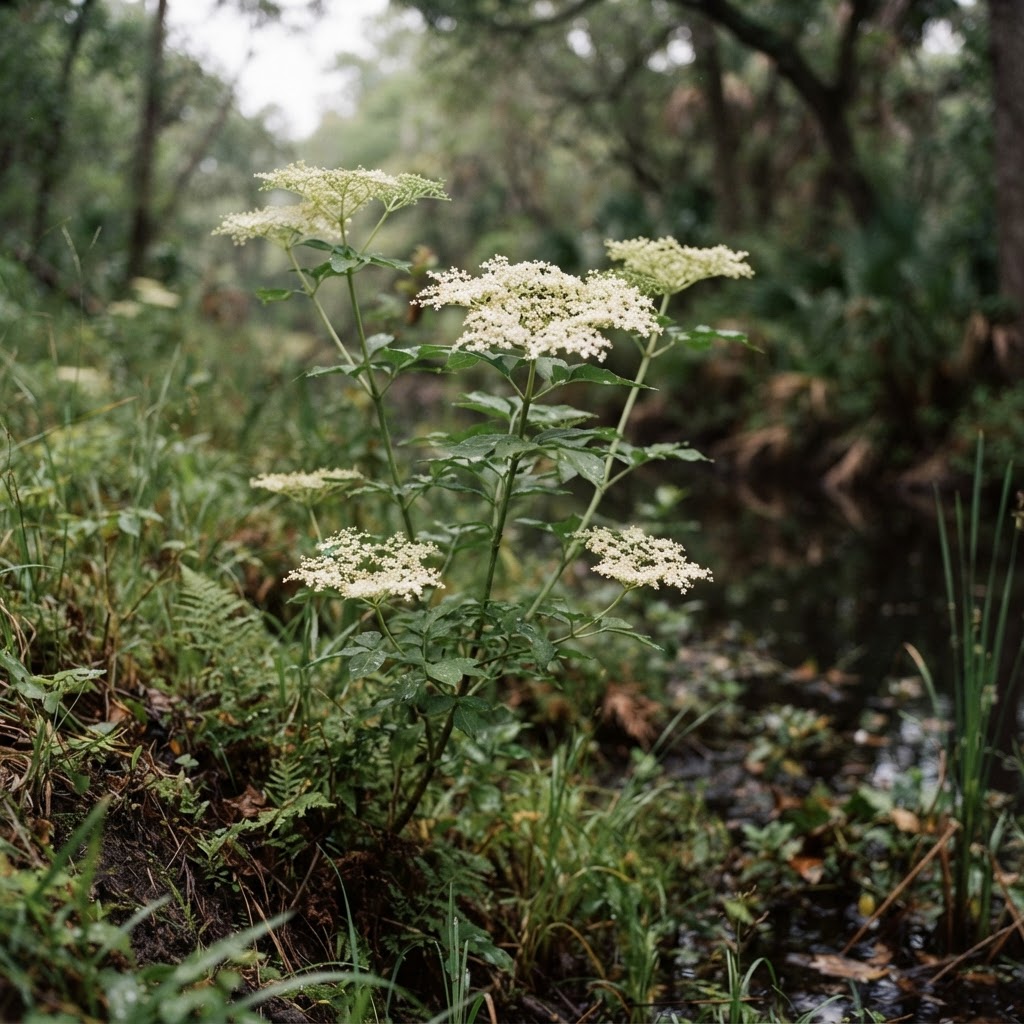
The American elderberry grows in the damp low places, along the ditch banks and the edges of the marshy ground, where it puts up tall, soft stems crowned by broad white flowers in flat plates through the early summer. The flowers are light and faintly sweet, and the dark berries that follow them are small, acid, and not to be eaten raw — but cooked, they become something else. The old dark color that comes out of them is not a dye but a kind of record, holding compounds that the cultivated fruits have mostly bred away. It is a plant of the margins, and it has held its place in practice for as long as anyone can remember.
1Cultural and Historical Significance
Native to the eastern and central United States through the Gulf states, the American Elderberry (Sambucus nigra subsp. canadensis) grows in the damp low places — along the ditch banks and the edges of the marshy ground — where it puts up tall, soft stems crowned by broad white flowers in flat plates through the early summer. The flowers are light and faintly sweet, and the dark berries that follow them are small, acid, and not to be eaten raw — but cooked, they become something else. Indigenous nations of the East and Gulf ate the cooked fruit and used the flowers and bark in traditional practice for fevers, colds, and skin complaints, and the plant entered European and American folk medicine as a primary cold-season remedy. The old dark color that comes out of the berries is not a dye but a kind of record, holding compounds the cultivated fruits have mostly bred away. Evolving in damp, competitive, microbe-rich ground, S. nigra developed a chemistry of dark-fruit anthocyanins, viral-neuraminidase-inhibiting lectins, and rutin that defends its tissues and drives its renowned antiviral and vascular effects.
Botanical Sexuality
American elderberry is hermaphroditic, bearing perfect (bisexual) flowers — small, white, five-petaled, in broad, flat-topped clusters (corymbs). The flowers open in early summer and are visited heavily by pollinators.
Reproductive Features
The flowers appear in broad, flat-topped white clusters six to ten inches across, with a faintly sweet, musky fragrance. Fertilized flowers develop into small, round, purple-black berries in drooping clusters in late summer, each holding small seeds — acid and not safely edible raw, but rich when cooked.
Foliage Identification
Leaves are opposite, pinnately compound, with five to seven leaflets, bright green and serrated, three to eight inches long. The stems are soft, pithy, and green when young, with raised lenticels; old stems develop rough, warty bark. The shrub grows in dense, multi-stemmed clumps in damp ground.
Harvesting Implications & Foliar Potency
Early-summer flowers carry the peak concentration of flavonoid glycosides and mucilage. Late-summer ripe berries hold the densest anthocyanin, lectin, and rutin fraction — the primary resource for antiviral and vascular extracts. Never harvest or use the stems, leaves, or roots, which carry cyanogenic compounds.
2Chemical Composition and Bioactive Constituents
American Elderberry holds a chemistry of dark-fruit anthocyanins (cyanidin-3-glucoside), viral-neuraminidase-inhibiting lectins, rutin, and quercetin. The anthocyanins and lectins carry the plant's renowned antiviral weight, while the rutin and quercetin drive its vascular effects.
3Mechanisms of Action and Systemic Physiological Effects
A. Neurological and Central Nervous System Effects
The anthocyanin and quercetin fractions cross the blood-brain barrier to quench reactive oxygen species and reinforce cerebral micro-vessels, supporting cognitive resilience against oxidative and inflammatory wear — though elderberry is primarily an antiviral and vascular botanical.
B. Systemic Physiological Effects
Systemically, the dark-fruit anthocyanins and viral-neuraminidase-inhibiting lectins reduce influenza duration and severity by blocking viral release from infected cell membranes, shown in clinical research. High concentrations of rutin, quercetin, and anthocyanins reinforce capillary wall integrity, reduce vascular fragility, and defend dermal collagen from oxidative and glycation damage.
C. Extraction and Preparation Profiles
Cold Extraction
(Spring Sap / Cold Maceration)
What Is Gained
Cold maceration of ripe cooked berries or fresh flowers draws off water-soluble anthocyanins, soluble lectins, rutin, and quercetin glycosides into a brilliant, tart, deep-purple liquor. Unheated, it preserves the heat-sensitive anthocyanins and the viral-neuraminidase-inhibiting lectins, delivering gentle antiviral and vascular support.
What Is Lost
The lipophilic quercetin aglycones remain locked in the berry and flower tissue. Cold extraction forfeits deep central neuroprotection and the full oncolytic anthocyanin pathways.
What Happens to You
Decoction
(Boiling / Heat Maceration)
What Is Gained
Boiling ripe berries (always cooked, never raw) ruptures the cells, liberating the full anthocyanins, free quercetin, water-dispersible rutin, and lectins into a warm, tart, astringent decoction — the traditional elderberry syrup base. Heat denatures the cyanogenic compounds in any residual stem material (use only berries), while heat-liberated anthocyanins and lectins exert their full antiviral and vascular effect.
What Is Lost
Prolonged boiling degrades a portion of the heat-sensitive anthocyanins and viral lectins, and fails to dissolve the strongly lipophilic quercetin aglycones. Decoction therefore forfeits peak oncolytic anthocyanin extraction and some of the deep antiviral lectin activity.
What Happens to You
Fermentation with Wild Yeast
(Spontaneous Viticulture & Ethanol Extraction)
What Is Gained
Fermenting cooked berries or flower extracts with wild yeasts generates ethanol, which dissolves the non-polar quercetin aglycones and lipophilic anthocyanin fractions that water cannot reach. Microbial enzymes cleave glycosidic bonds, freeing maximally bioavailable quercetin and anthocyanin aglycones that cross the blood-brain barrier to engage the plant's defining central and oncolytic signaling, while surviving lectins continue their antiviral action.
Cancer Destruction & Oncolytic Powers
Extracted via amphiphilic alcoholic fermentation, the quercetin and anthocyanin aglycones act as multi-targeted agents against malignant cell lines. They induce G₁ cell-cycle arrest by downregulating Cyclin D1 and CDK4, shift the Bax/Bcl-2 balance toward intrinsic apoptosis via caspase-9 and caspase-3, inhibit VEGF and matrix metalloproteinases to suppress angiogenesis and metastasis, and suppress NF-κB to strip away the pro-inflammatory cytokine microenvironment (TNF-α, IL-6) tumors exploit.
What Is Lost
Yeast metabolism converts the berries' natural sugars into ethanol and carbon dioxide, eliminating the bright sweet-tartness of the syrup. The fermented liquor is dry, tart, and astringent — the basis, historically, of elder wine.
What Happens to You
4Safety, Toxicology, and Precautions
Raw Berries, Stems, and Leaves
Raw berries, and all stems, leaves, bark, and roots, contain cyanogenic glycosides that release cyanide-like compounds and cause nausea, vomiting, and diarrhea. Only fully ripe berries, cooked, and the flowers are safe for use.
Diuretic Effect
Elderberry preparations have a mild diuretic effect; those on diuretic medications should be aware and maintain hydration.