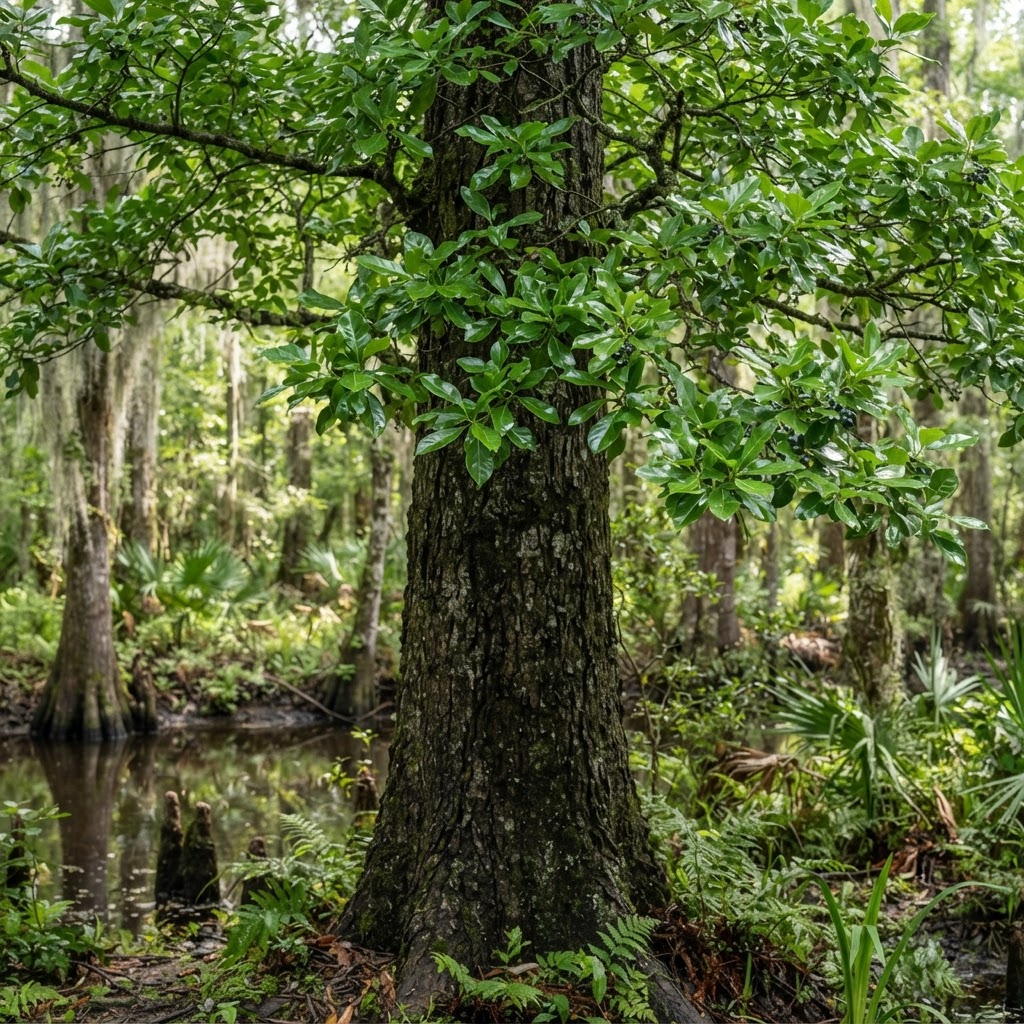
The black tupelo is a tree of the swamp margins and the low hills, plain enough through the summer and then, for two weeks in the fall, the brightest thing in the southern woods. It turns a deep, clear scarlet that no other tree matches, and it does it alone, early, before the rest of the forest has decided what to do. The leaves are simple and oval, the bark is dark and blocky, and the fruit is small and sour. It is a tree that does its real work quietly and saves its one clear statement for a single, late season.
1Cultural and Historical Significance
Native to the eastern United States from New England through the Gulf states, the Black Tupelo or Black Gum (Nyssa sylvatica) is a tree of the swamp margins and the low upland hills, plain enough through the summer and then, for two weeks in early autumn, the brightest thing in the southern woods — a deep, clear scarlet no other tree matches. Indigenous nations of the East and Gulf valued its sour dark fruit and used its bark and roots in traditional practice for skin complaints and fevers. Early settlers knew it as a tough, cross-grained wood that warped neither wet nor dry, prized for mauls, wheel hubs, and butcher blocks. Evolving on acid, waterlogged soils and in the shade of taller canopy trees, N. sylvatica developed a flavonoid chemistry — quercetin and kaempferol glycosides — that protects its foliage against oxidative damage and gives it that unmatched autumn color.
Botanical Sexuality
Black tupelo is strongly dioecious, with male and female flowers borne on separate trees. The small, greenish-yellow flowers open in spring as the leaves emerge, the female trees alone producing fruit.
Reproductive Features
Male flowers cluster in small spherical heads; female flowers sit singly or in pairs on long stalks. Fertilized flowers develop into small, oval, dark-blue drupes — sour and astringent when ripe — that hang on long stems through late autumn and are taken eagerly by birds.
Foliage Identification
Leaves are simple, oval, two to five inches long, glossy dark green above and paler beneath, with smooth margins that may wave slightly. The bark is dark grey-brown and develops deep, blocky ridges resembling alligator hide on mature trunks — one of the most reliable field marks. The branching is distinctly horizontal, giving the crown a layered, tiered silhouette.
Harvesting Implications & Foliar Potency
Spring leaves and flowers carry accessible flavonoid glycosides and trace organic acids. Autumn fruit and bark concentrate the densest flavonoid and tannin fractions, the primary biological resource for antioxidant and vascular-protective extracts.
2Chemical Composition and Bioactive Constituents
Black Tupelo holds a flavonoid-rich profile dominated by quercetin and kaempferol glycosides, alongside condensed tannins and chlorogenic acid. These compounds neutralize reactive oxygen and nitrogen species and interfere with the formation of Advanced Glycation End-products, preserving tissue structure.
3Mechanisms of Action and Systemic Physiological Effects
A. Neurological and Central Nervous System Effects
Quercetin and kaempferol fractions cross the blood-brain barrier to quench reactive oxygen species in neural tissue and suppress microglial activation during sustained stress. By interfering with glycation chemistry, these flavonoids help protect cerebral micro-vessels and protein structure from age-related stiffening.
B. Systemic Physiological Effects
Systemically, the flavonoid and tannin fractions scavenge free radicals and reactive nitrogen species, shielding cellular DNA from environmental and metabolic wear. Condensed tannins lend mild astringent tone to mucosal tissue, while the anti-glycation action preserves the elasticity of skin and vessel walls.
C. Extraction and Preparation Profiles
Cold Extraction
(Spring Sap / Cold Maceration)
What Is Gained
Cold maceration of fresh leaves or ripe fruit draws off water-soluble quercetin and kaempferol glycosides, chlorogenic acid, and trace fruit acids into a light, tart, faintly astringent liquor. Unheated, it preserves the delicate flavonoid glycosides that support gentle antioxidant and vascular protection.
What Is Lost
Condensed tannins and lipophilic flavonoid aglycones remain largely locked in the leaf and fruit cell walls. Cold extraction forfeits deep central neuroprotection, full anti-glycation signaling, and any oncolytic pathways that require ethanol.
What Happens to You
Decoction
(Boiling / Heat Maceration)
What Is Gained
Boiling leaves, fruit, or inner bark ruptures the cell walls, liberating condensed tannins, free quercetin and kaempferol, and water-dispersible phenolic glycosides into a dark, astringent decoction. Heat-liberated tannins tone digestive mucosa and flatten post-meal glycemic curves, while free flavonoids reinforce vascular collagen.
What Is Lost
Prolonged boiling degrades a portion of the heat-sensitive glycosides and fails to dissolve the non-polar flavonoid aglycones. Decoction therefore forfeits peak lipophilic neuroprotection and the deepest oncolytic flavonoid extraction.
What Happens to You
Fermentation with Wild Yeast
(Spontaneous Viticulture & Ethanol Extraction)
What Is Gained
Fermenting fruit or leaf extracts with wild yeasts generates ethanol, which dissolves the non-polar flavonoid aglycones and lipophilic phenolics that water cannot reach. Microbial enzymes cleave glycosidic bonds, freeing maximally bioavailable quercetin and kaempferol aglycones that cross the blood-brain barrier to engage the tree's defining central and oncolytic signaling.
Cancer Destruction & Oncolytic Powers
Extracted via amphiphilic alcoholic fermentation, quercetin and kaempferol aglycones act as multi-targeted agents against malignant cell lines. They induce G₁ cell-cycle arrest by downregulating Cyclin D1 and CDK4, shift the Bax/Bcl-2 balance toward intrinsic apoptosis via caspase-9 and caspase-3, inhibit VEGF and matrix metalloproteinases to suppress angiogenesis and metastasis, and suppress NF-κB to strip away the pro-inflammatory cytokine microenvironment (TNF-α, IL-6) tumors exploit.
What Is Lost
Yeast metabolism converts fruit sugars into ethanol and carbon dioxide, eliminating the bright fruity sweetness and immediate caloric lift of the cold extract. The fermented liquor is dry, tart, and tannic, forfeiting the gentle spring-leaf palate.
What Happens to You
4Safety, Toxicology, and Precautions
Raw Fruit in Bulk
The ripe drupes are sharply sour and astringent from tannins; eaten in quantity they irritate the gastric mucosa and can cause nausea. They are best taken in moderation or after preparation that softens their tannic edge.
Concentrated Bark Decoctions
Heavy inner-bark preparations carry dense tannins that, in excess, bind dietary minerals and irritate the stomach lining. Keep such decoctions moderate and intermittent.