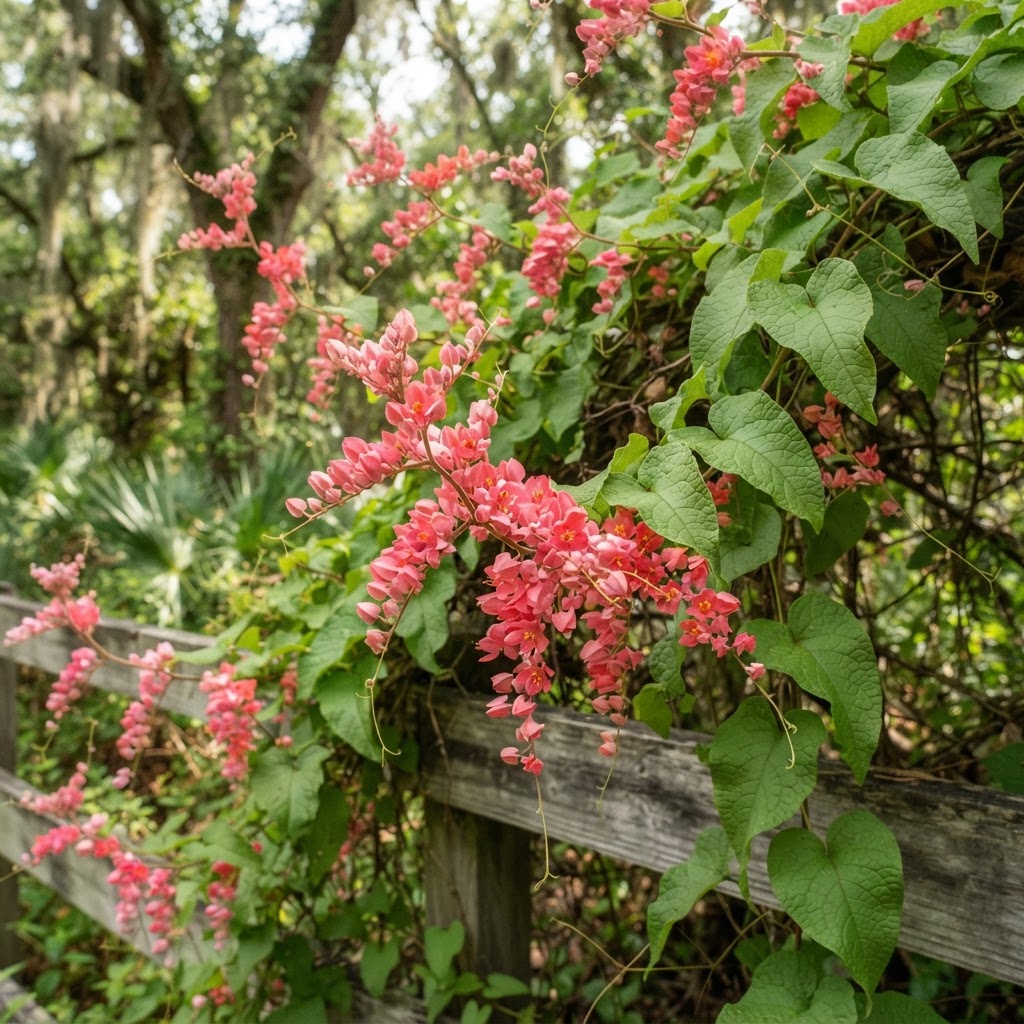
The coral vine is a plant that travels. It climbs whatever it finds — fence, shed, dead tree — and covers it through the late summer with a cascading sheet of pink flowers so dense the structure beneath simply disappears. In a single season it can swallow a shed. Yet in the colder edges of its range it dies back to the ground each winter, returning patiently from the tuber below. It is an opportunist, but a generous one; the bees come to it in great numbers when little else is in flower.
1Cultural and Historical Significance
Native to Mexico and spread across the Gulf Coast and the American Southeast, the Coral Vine or Mexican Creeper (Antigonon leptopus) is a plant that travels — climbing whatever it finds, fence, shed, or dead tree, and covering it through the late summer with a cascading sheet of pink flowers so dense the structure beneath simply disappears. Indigenous peoples of Mexico and the Gulf used its tubers, seeds, and flowers in traditional practice, and the plant has long been grown as much for ornament as for use. In the colder edges of its range it dies back to the ground each winter, returning patiently from the tuber below — an opportunist, but a generous one, the bees coming to it in great numbers when little else flowers. Evolving in hot, competitive edge habitat, A. leptopus developed a chemistry of phenolics, quercetin glycosides, and anthocyanins that defends its rapid-growth foliage against oxidative and insect stress.
Botanical Sexuality
Coral vine is hermaphroditic, bearing perfect (bisexual) flowers — each bloom containing both male and female reproductive parts. The flowers open in long, trailing racemes through the late summer and fall.
Reproductive Features
The flowers are small, vivid pink (occasionally white), five-petaled, and borne in long, drooping racemes that cascade from the vine. Fertilized flowers develop into small, triangular, winged achenes that catch the wind and allow the vine to colonize new ground.
Foliage Identification
Leaves are alternate, heart-shaped to arrow-shaped, two to four inches long, with prominent basal lobes and a long pointed tip. The stems are slender, twining, and armed with small tendrils that grip any support. A large, starchy tuber sits below ground, allowing the vine to resprout each spring after frost kills the top growth.
Harvesting Implications & Foliar Potency
Late-summer flowers carry the peak concentration of anthocyanins and flavonoid glycosides. Autumn leaves and seeds hold the densest phenolic and quercetin fractions — the primary resource for anti-inflammatory and oncolytic extracts.
2Chemical Composition and Bioactive Constituents
Coral Vine holds a phenolic chemistry of quercetin glycosides, anthocyanin pigments, and specialized antispasmodic phenolics. The anthocyanins carry the plant's antioxidant and cytotoxic weight, while the phenolic fractions suppress lipid peroxidation and inflammatory enzyme signaling.
3Mechanisms of Action and Systemic Physiological Effects
A. Neurological and Central Nervous System Effects
The phenolic and quercetin fractions modulate central neuroinflammation and calm peripheral nerve excitability, exhibiting natural analgesic signaling without central nervous system depression. Quercetin crosses the blood-brain barrier to quench reactive oxygen species in neural tissue.
B. Systemic Physiological Effects
Systemically, extracts exert strong lipid-peroxidation inhibition and COX-2 enzyme suppression comparable to non-steroidal anti-inflammatory agents. Concentrated anthocyanins and bioflavonoids demonstrate notable cytotoxic activity against selective cancer cell lines by inhibiting tumor angiogenesis and scavenging reactive oxygen species.
C. Extraction and Preparation Profiles
Cold Extraction
(Spring Sap / Cold Maceration)
What Is Gained
Cold maceration of fresh flowers or leaves draws off water-soluble anthocyanins, quercetin glycosides, and trace organic acids into a brilliant, pink, lightly tart liquor. Unheated, it preserves the heat-sensitive anthocyanins and supports gentle antioxidant and vascular protection.
What Is Lost
Lipophilic flavonoid aglycones and antispasmodic phenolics remain locked in the leaf tissue. Cold extraction forfeits the full anti-inflammatory COX-2 suppression and any oncolytic anthocyanin pathways that require ethanol.
What Happens to You
Decoction
(Boiling / Heat Maceration)
What Is Gained
Boiling leaves or flowers ruptures the cells, liberating the full quercetin glycosides, a portion of the anthocyanins, and water-dispersible phenolics into a warm, tart, astringent decoction. Heat-liberated phenolics suppress lipid peroxidation and reinforce vascular collagen, while the warm liquid supports peripheral circulation.
What Is Lost
Prolonged boiling degrades a significant portion of the heat-sensitive anthocyanins and fails to dissolve the non-polar flavonoid aglycones. Decoction therefore forfeits peak oncolytic anthocyanin extraction and the deep anti-inflammatory COX-2 suppression.
What Happens to You
Fermentation with Wild Yeast
(Spontaneous Viticulture & Ethanol Extraction)
What Is Gained
Fermenting flower, leaf, or seed extracts with wild yeasts generates ethanol, which dissolves the non-polar flavonoid and anthocyanin aglycones that water cannot reach. Microbial enzymes cleave glycosidic bonds, freeing maximally bioavailable quercetin and anthocyanin aglycones that cross the blood-brain barrier to engage the plant's defining central and oncolytic signaling.
Cancer Destruction & Oncolytic Powers
Extracted via amphiphilic alcoholic fermentation, quercetin and anthocyanin aglycones act as multi-targeted agents against selective malignant cell lines. They induce G₁ cell-cycle arrest by downregulating Cyclin D1 and CDK4, shift the Bax/Bcl-2 balance toward intrinsic apoptosis via caspase-9 and caspase-3, inhibit VEGF and matrix metalloproteinases to suppress angiogenesis and metastasis, and suppress NF-κB and COX-2 to strip away the pro-inflammatory cytokine microenvironment (TNF-α, IL-6) tumors exploit.
What Is Lost
Yeast metabolism converts flower sugars into ethanol and carbon dioxide, eliminating the bright, sweet floral palate. The fermented liquor is dry, tart, and tannic, forfeiting the gentle spring-flower character.
What Happens to You
4Safety, Toxicology, and Precautions
Raw Tubers in Excess
The starchy tuber is edible when cooked but raw, in quantity, carries oxalates and astringent tannins that can irritate the mouth and stomach. Cook thoroughly and avoid large servings.
Seed Coat Astringency
The winged seeds carry fibrous coats and residual tannins; consuming them crude in bulk can cause mild gastrointestinal distress.