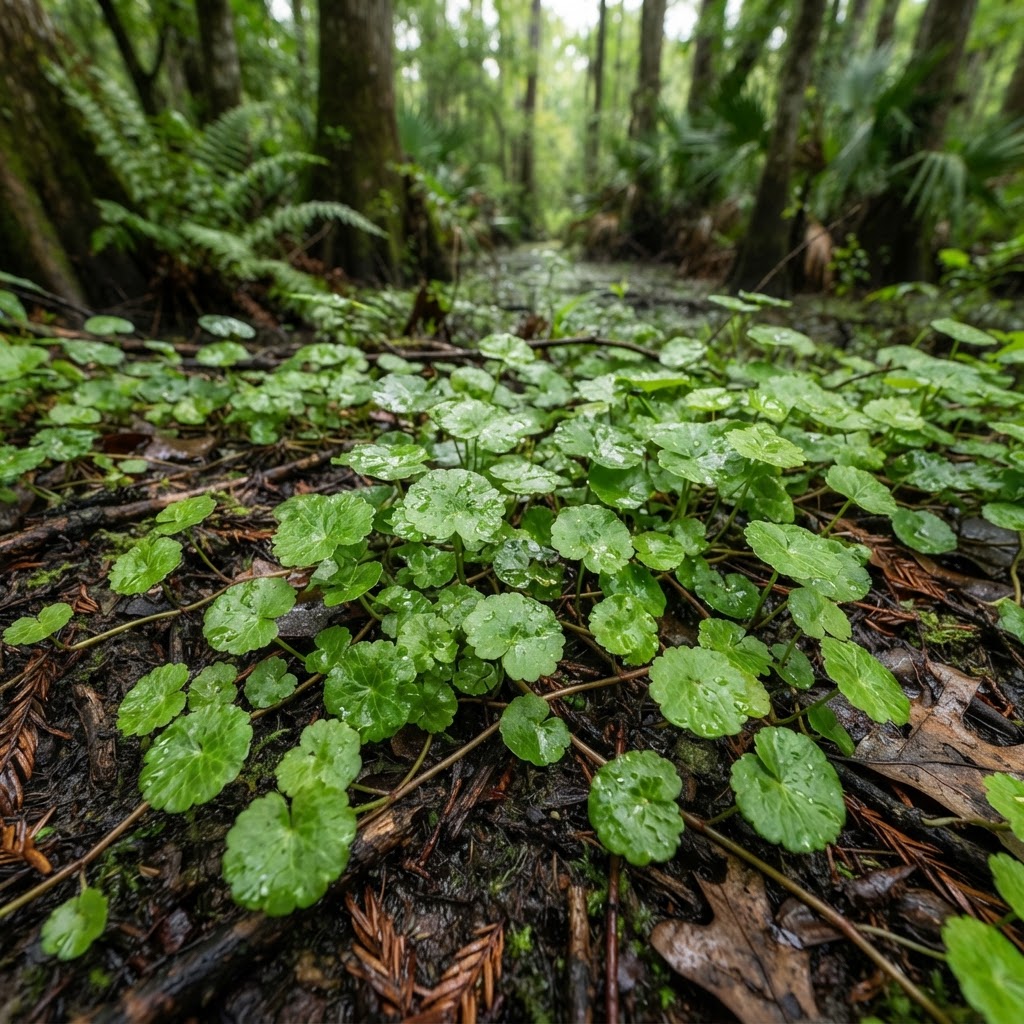
Pennywort grows where water sits. You find it in damp lawns, along the edges of drainage ditches, and in the soft ground at the base of gutter downspouts, its small round leaves held like coins on thin stems. It never becomes anything impressive to look at, and yet it has held a place in folk practice for longer than anyone has been writing these things down. The leaves are faintly bitter, cool to the taste, and the plant seems to belong to the kind of quiet, unremarkable ground that most people step across without noticing.
1Cultural and Historical Significance
Native to the tropical and subtropical regions of the world, including the Gulf Coast, Pennywort or Gotu Kola (Centella / Hydrocotyle spp.) grows where water sits — in damp lawns, along the edges of drainage ditches, and in the soft ground at the base of gutter downspouts, its small round leaves held like coins on thin stems. It has held a place in folk practice across Asia, Africa, and the American Gulf for longer than anyone has been writing these things down, used traditionally to sharpen memory, heal wounds, and soothe the skin. The leaves are faintly bitter, cool to the taste, and the plant seems to belong to the kind of quiet, unremarkable ground that most people step across without noticing. Evolving in damp, competitive ground, Centella developed a chemistry of triterpenoid saponins — asiaticoside and madecassoside — that defend its creeping tissues and drive its renowned wound-healing and cognitive effects.
Botanical Sexuality
Pennywort is hermaphroditic, bearing tiny perfect flowers in small, tight, greenish-white umbels beneath the leaves, close to the ground. The flowers are inconspicuous and easily overlooked.
Reproductive Features
The minute flowers cluster in short, rounded umbels on stalks shorter than the leaves, often hidden beneath the leaf canopy. Fertilized flowers develop into tiny, flattened, ribbed schizocarps that split into paired halves, scattering seed close to the parent plant.
Foliage Identification
Leaves are the defining mark: small, round, kidney- to coin-shaped, one to two inches across, bright green and glossy, held like lily pads on slender, erect petioles that rise directly from creeping runners. The stems are smooth and succulent, rooting at the nodes, so a single plant can colonize a wide patch of wet ground.
Harvesting Implications & Foliar Potency
Spring and early-summer leaves carry the peak concentration of the triterpenoid saponins asiaticoside and madecassoside — the primary resource for cognitive and wound-healing extracts. Harvest by pinching the leaves from the creeping runners, leaving the roots to regrow.
2Chemical Composition and Bioactive Constituents
Pennywort holds a triterpenoid-saponin chemistry of asiaticoside and madecassoside, alongside flavonoids and a soft mucilage. These saponins are the plant's defining compounds — they stimulate collagen synthesis, support micro-vascular circulation, and sharpen cognitive function.
3Mechanisms of Action and Systemic Physiological Effects
A. Neurological and Central Nervous System Effects
Asiaticoside and madecassoside stimulate Brain-Derived Neurotrophic Factor (BDNF), sharpening memory retrieval, processing speed, and cognitive endurance. The same triterpenoids mitigate beta-amyloid toxicity in neural tissue, supporting long-range cognitive resilience.
B. Systemic Physiological Effects
Systemically, the triterpenoid saponins are renowned for promoting micro-vascular circulation and collagen synthesis — visibly improving skin firmness, accelerating wound repair, and strengthening capillary walls. The flavonoid fraction reinforces vascular integrity and scavenges free radicals.
C. Extraction and Preparation Profiles
Cold Extraction
(Spring Sap / Cold Maceration)
What Is Gained
Cold maceration of fresh crushed leaves draws off water-soluble asiaticoside, madecassoside, and flavonoid glycosides into a light, faintly bitter, cooling liquor. Unheated, it preserves the heat-sensitive triterpenoid saponins and delivers gentle cognitive and micro-vascular support.
What Is Lost
The lipophilic triterpene aglycones (asiatic acid, madecassic acid) remain locked in the leaf cell walls. Cold extraction forfeits peak collagen-stimulating power and any oncolytic triterpenoid pathways that require ethanol.
What Happens to You
Decoction
(Boiling / Heat Maceration)
What Is Gained
Boiling fresh leaves ruptures the cell walls, liberating the full triterpenoid saponins, free asiatic acid, and water-dispersible flavonoids into a warm, faintly bitter decoction. Heat-liberated saponins stimulate collagen synthesis and wound repair, while the warm liquid supports micro-vascular circulation.
What Is Lost
Prolonged boiling degrades a portion of the heat-sensitive saponins and fails to dissolve the strongly lipophilic triterpene aglycones fully. Decoction therefore forfeits peak collagen-stimulation and the deepest oncolytic triterpene extraction.
What Happens to You
Fermentation with Wild Yeast
(Spontaneous Viticulture & Ethanol Extraction)
What Is Gained
Fermenting crushed leaves with wild yeasts generates ethanol, which dissolves the non-polar asiatic acid and madecassic acid aglycones that water cannot reach. Microbial enzymes cleave glycosidic bonds, freeing maximally bioavailable triterpene aglycones that cross the blood-brain barrier to engage the plant's defining central and oncolytic signaling.
Cancer Destruction & Oncolytic Powers
Extracted via amphiphilic alcoholic fermentation, asiatic acid and madecassic acid aglycones act as multi-targeted agents against malignant cell lines. They induce cell-cycle arrest by downregulating Cyclin D1 and CDK4, shift the Bax/Bcl-2 balance toward intrinsic apoptosis via caspase-9 and caspase-3, inhibit VEGF and matrix metalloproteinases to suppress angiogenesis and metastasis, and suppress NF-κB to strip away the pro-inflammatory cytokine microenvironment (TNF-α, IL-6) tumors exploit.
What Is Lost
Yeast metabolism consumes leaf carbohydrates into ethanol and carbon dioxide. The fermented liquor is dry, bitter, and slightly medicinal, forfeiting the cool, fresh, green palate of the cold extract.
What Happens to You
4Safety, Toxicology, and Precautions
Topical Sensitization
Fresh crushed leaves applied directly to broken skin can, in rare cases, cause contact dermatitis. Test on a small area first, and avoid use on deep, infected wounds without proper cleansing.
Sedative Interaction
In high doses pennywort can have a mild sedative effect; those taking sedative medications should approach concentrated preparations with caution.