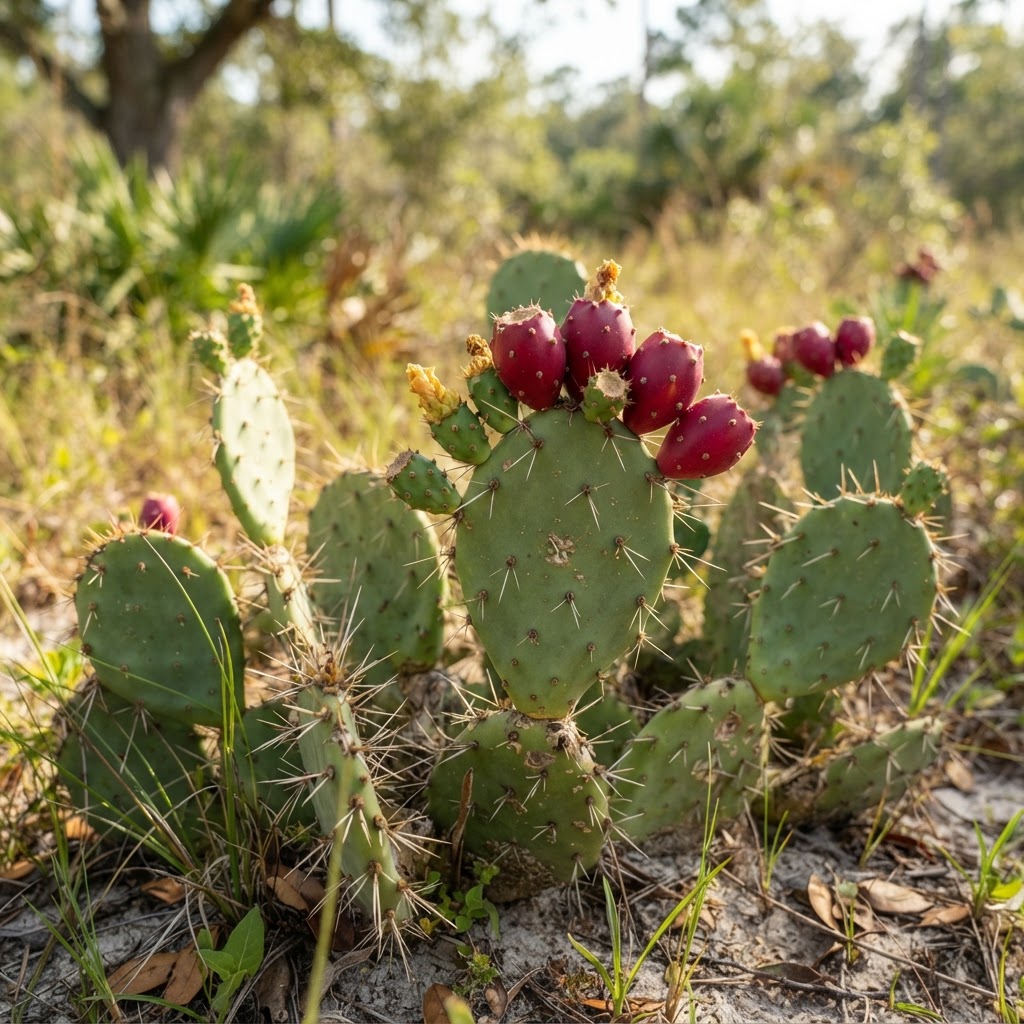
The prickly pear grows where the ground is poor and dry and gives nothing back easily. Its pads are not leaves but stems, flattened and jointed, and they store water against the long summers with a kind of stubborn thrift. The spines are obvious enough; the smaller, hair-like glochids are worse, and a man who has brushed against one learns to respect the plant whether he wants to or not. In the early summer it flowers in a startling yellow, and the fruit that follows is sweet if you can get past the defenses. It is a plant that expects nothing and holds its ground.
1Cultural and Historical Significance
Native to the Americas and long naturalized across the Gulf and Southwest, the Prickly Pear (Opuntia spp.) grows where the ground is poor and dry and gives nothing back easily. Its pads are not leaves but stems, flattened and jointed, and they store water against the long summers with a kind of stubborn thrift. The spines are obvious enough; the smaller, hair-like glochids are worse, and a person who has brushed against one learns to respect the plant whether they want to or not. Indigenous nations of the Gulf, Southwest, and Mexico ate the pads (nopales) and fruit (tunas) as staples, and used the pads and juice in traditional practice for wounds, burns, and metabolic complaints — the plant entering both food and medicine. Evolving in arid, sun-blasted ground, Opuntia developed a chemistry of rare betalain pigments, soluble pectin fibers and mucilage, and vitamin E that defends its water-storing tissues against oxidative and thermal stress.
Botanical Sexuality
Prickly pear is hermaphroditic, bearing perfect (bisexual) flowers — large, showy, yellow-to-red blooms with numerous stamens. The flowers open in early summer and are pollinated by bees and other insects.
Reproductive Features
The flowers are large, three to four inches across, bright yellow, orange, or red, bowl-shaped, with many tepals and a central cluster of stamens. Fertilized flowers develop into the fleshy, pear- or barrel-shaped fruit (tuna), green ripening to red, purple, or yellow, covered in glochids, with seedy, sweet, vividly pigmented flesh inside.
Foliage Identification
The 'leaves' are actually flattened, jointed stem segments (cladodes or pads), oval to oblong, six to ten inches long, thick and water-storing, medium green. Spines emerge from cushion-like areoles, and the smaller, hair-like glochids — the plant's worse defense — cluster at the areole base. The plant grows as a low, branching, sprawling cluster of pads.
Harvesting Implications & Foliar Potency
Early-summer flowers and ripe fruit carry the peak concentration of betalain pigments and vitamin E. Year-round young pads hold the soluble pectin and mucilage fraction — the primary resource for glycemic and demulcent extracts. Use tongs and gloves; the glochids are the real hazard.
2Chemical Composition and Bioactive Constituents
Prickly Pear holds a distinctive cactus chemistry of rare betalain pigments (betacyanins and betaxanthins), soluble pectin fibers and mucilage, and vitamin E. The betalains carry the plant's antioxidant and oncolytic weight, while the pectin fibers and mucilage drive its renowned glycemic effects.
3Mechanisms of Action and Systemic Physiological Effects
A. Neurological and Central Nervous System Effects
The betalain pigments and vitamin E defend neural cell membranes against lipid peroxidation, and the mucilaginous fractions support stable blood-sugar delivery to the brain, sustaining even cognitive energy without the spike-and-fall of refined sugars — though prickly pear is primarily a metabolic botanical.
B. Systemic Physiological Effects
Systemically, the soluble pectin fibers and mucilage gently modulate glucose absorption, offering exceptional support for glycemic balance and metabolic wellness in Type 2 diabetes, backed by human clinical research. The rare betalain pigments and vitamin E defend cell membranes against lipid peroxidation, induce apoptosis in mutated cell cultures, and restore dermal elasticity.
C. Extraction and Preparation Profiles
Cold Extraction
(Spring Sap / Cold Maceration)
What Is Gained
Cold maceration of ripe fruit or scraped young pads draws off water-soluble betalains, soluble pectin, mucilage, and vitamin C into a brilliant, vivid magenta liquor. Unheated, it preserves the heat-sensitive betalains and delivers gentle glycemic modulation, rapid hydration, and dermal antioxidant protection.
What Is Lost
The lipophilic vitamin E and the deep membrane-bound betalain fractions remain locked in the pad tissue. Cold extraction forfeits peak lipid-peroxidation defense and any oncolytic betalain pathways that require ethanol.
What Happens to You
Decoction
(Boiling / Heat Maceration)
What Is Gained
Boiling scraped pads or crushed fruit ruptures the cells, liberating the full soluble pectin, mucilage, water-dispersible betalains, and a portion of vitamin E into a warm, soft, demulcent decoction. Heat-liberated pectin and mucilage modulate glucose absorption strongly, while the warm liquid coats and soothes gastric mucosa.
What Is Lost
Prolonged boiling degrades a significant portion of the heat-sensitive betalains and vitamin C, and fails to dissolve the strongly lipophilic vitamin E fully. Decoction therefore forfeits peak lipid-peroxidation defense and the deepest oncolytic betalain extraction.
What Happens to You
Fermentation with Wild Yeast
(Spontaneous Viticulture & Ethanol Extraction)
What Is Gained
Fermenting crushed fruit or pad extracts with wild yeasts generates ethanol, which dissolves the non-polar vitamin E and lipophilic betalain fractions that water cannot reach. Microbial enzymes cleave glycosidic bonds, freeing maximally bioavailable betalain and tocopherol aglycones that cross the blood-brain barrier to engage the plant's defining central and oncolytic signaling.
Cancer Destruction & Oncolytic Powers
Extracted via amphiphilic alcoholic fermentation, the betalain aglycones and vitamin E act as multi-targeted agents against malignant cell lines. They induce cell-cycle arrest by downregulating Cyclin D1 and CDK4, defend cell membranes against lipid peroxidation to push damaged cells toward intrinsic apoptosis via caspase-9 and caspase-3, inhibit VEGF and matrix metalloproteinases to suppress angiogenesis and metastasis, and suppress NF-κB to strip away the pro-inflammatory cytokine microenvironment (TNF-α, IL-6) tumors exploit.
What Is Lost
Yeast metabolism converts the fruit's natural sugars into ethanol and carbon dioxide, eliminating the bright sweetness and immediate hydration of the cold extract. The fermented liquor is dry, slightly bitter, and earthy, and the soft demulcent texture is reduced by the alcohol.
What Happens to You
4Safety, Toxicology, and Precautions
Glochids
The hair-like glochids at the areole base detach easily and lodge painfully in skin and mucous membranes; they are a genuine hazard. Singe them off over a flame or scrape them away before any handling of pads or fruit for preparation.
Blood-Sugar Medication
Because the pectin and mucilage have genuine glucose-lowering effect, concentrated preparations can compound the effect of diabetes medications and risk hypoglycemia. Those on insulin or oral hypoglycemics should monitor blood sugar and moderate intake.