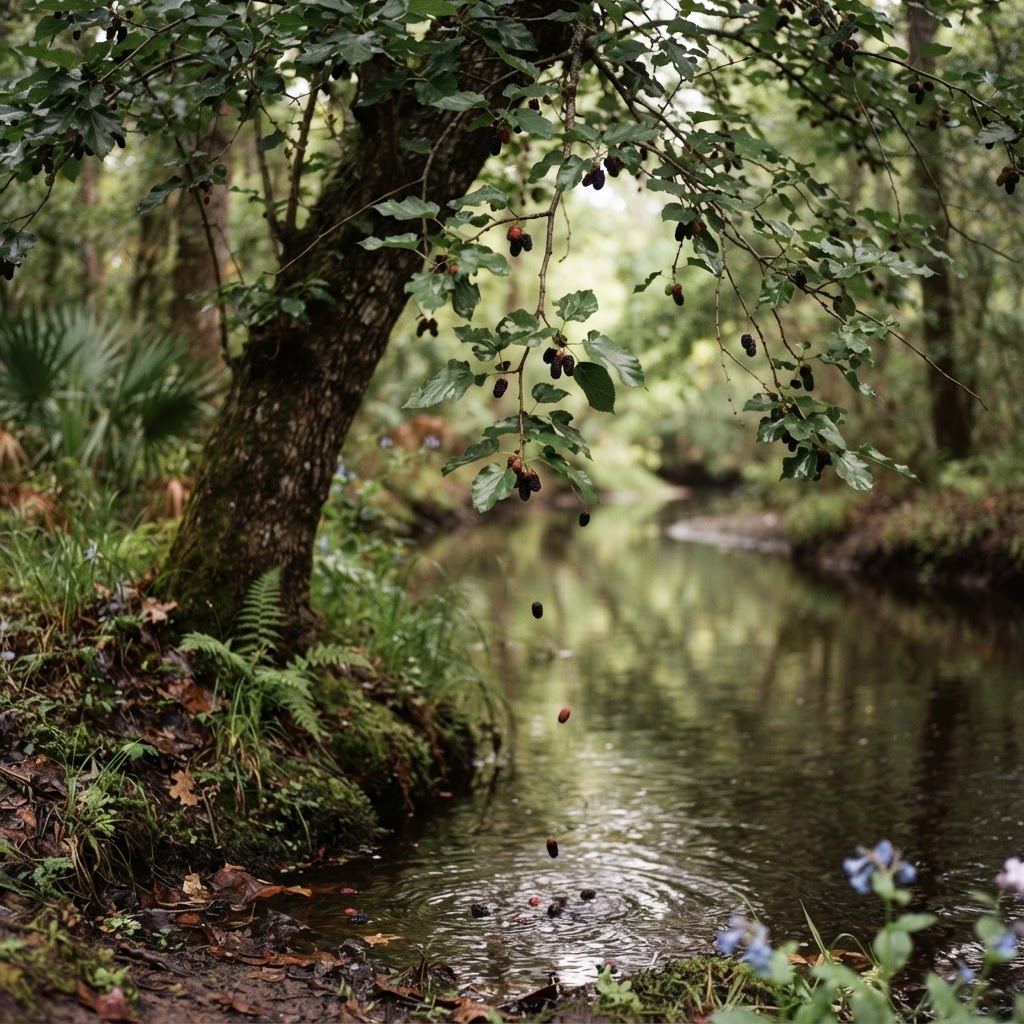
The red mulberry is the native mulberry of the southern woods, a tree of the rich bottomland and the stream banks, with broad, rough leaves that are dark green above and pale beneath. The fruit comes in the late spring, soft and dark, and it does not keep — a man has to eat it the day it falls, or the day he picks it, and the birds will usually have taken most of them first. The tree is fast-growing and short-lived, and it has been largely forgotten now that the sweeter cultivated mulberries have come in. But for a few weeks each year it is the best thing in the low woods.
1Cultural and Historical Significance
Native to the eastern and central United States through the Gulf states, the Red Mulberry (Morus rubra) is the native mulberry of the southern woods, a tree of the rich bottomland and the stream banks, with broad, rough leaves and a fruit that comes in the late spring, soft and dark, and does not keep — a person has to eat it the day it falls, or the day he picks it, and the birds will usually have taken most of them first. Indigenous nations of the East and Gulf ate the fruit eagerly and used the bark and roots in traditional practice, and early colonists made pies, preserves, and wine from the fruit. The tree is fast-growing and short-lived, and it has been largely forgotten now that the sweeter cultivated and invasive white mulberries have come in. But for a few weeks each year it is the best thing in the low woods. Evolving in competitive, wildlife-rich bottomland, M. rubra developed a chemistry of the potent α-glucosidase inhibitor 1-deoxynojirimycin (DNJ), resveratrol, and cyanidin anthocyanins that defends its fruit and foliage against microbial and oxidative stress.
Botanical Sexuality
Red mulberry is usually monoecious but often somewhat dioecious, bearing male and female flowers on the same or separate trees. The small, greenish flowers appear in spring as the leaves emerge.
Reproductive Features
Male flowers appear in slender, drooping catkins; female flowers in shorter, denser spikes. Fertilized flowers develop into the compound fruit — an aggregate of small drupelets resembling a elongated blackberry — green, then white, then red, and finally dark purple-black when ripe in late spring and early summer. The fruit is soft, sweet, and does not keep.
Foliage Identification
Leaves are large, alternate, broadly ovate, often deeply lobed (sometimes mitten-shaped), dark green and rough above, paler and softly hairy beneath, with serrated margins. The bark is reddish-brown and fibrous, and the tree bleeds a milky latex when cut, like all mulberries.
Harvesting Implications & Foliar Potency
Late-spring ripe fruit carries the peak concentration of DNJ, resveratrol, and cyanidin anthocyanins. Summer leaves hold the densest DNJ fraction — the primary resource for glycemic-control extracts.
2Chemical Composition and Bioactive Constituents
Red Mulberry holds a chemistry of the potent iminosugar 1-deoxynojirimycin (DNJ), resveratrol and related stilbenoids, and cyanidin anthocyanins in the fruit. DNJ is a powerful α-glucosidase inhibitor, the plant's defining metabolic compound, while the anthocyanins and resveratrol carry its oncolytic and antioxidant weight.
3Mechanisms of Action and Systemic Physiological Effects
A. Neurological and Central Nervous System Effects
Resveratrol and cyanidin fractions cross the blood-brain barrier to scavenge reactive oxygen species and modulate inflammatory signaling in neural tissue, supporting cognitive resilience against oxidative wear.
B. Systemic Physiological Effects
Systemically, DNJ is a potent α-glucosidase inhibitor that blunts post-meal glucose absorption and supports insulin sensitivity — comparable in mechanism to modern pharmaceutical glinides. The fruit's resveratrol and cyanidin anthocyanins induce cell-cycle arrest in mutated lines and scavenge reactive oxygen species across the vascular system.
C. Extraction and Preparation Profiles
Cold Extraction
(Spring Sap / Cold Maceration)
What Is Gained
Cold maceration of crushed ripe fruit or young leaves draws off water-soluble DNJ, anthocyanins, soluble resveratrol glycosides, and organic acids into a brilliant, sweet, deep-purple liquor. Unheated, it preserves the heat-sensitive DNJ and delivers rapid hydration, quick energy, and genuine post-meal glycemic control.
What Is Lost
The lipophilic resveratrol aglycones remain locked in the fruit and leaf tissue. Cold extraction forfeits peak neuroprotection and the oncolytic resveratrol and anthocyanin pathways.
What Happens to You
Decoction
(Boiling / Heat Maceration)
What Is Gained
Boiling crushed fruit or leaves ruptures the tissue, liberating free resveratrol, anthocyanins, and water-dispersible phenolic glycosides into a dark, sweet, astringent decoction. Heat-liberated compounds reinforce vascular collagen and scavenge plasma free radicals, while a portion of the heat-sensitive DNJ survives to support glycemic control.
What Is Lost
Prolonged boiling degrades a significant portion of the heat-sensitive DNJ and the anthocyanins, and fails to dissolve the strongly lipophilic resveratrol aglycones. Decoction therefore forfeits peak glycemic control and the deepest oncolytic extraction.
What Happens to You
Fermentation with Wild Yeast
(Spontaneous Viticulture & Ethanol Extraction)
What Is Gained
Fermenting crushed fruit or leaf extracts with wild yeasts generates ethanol, which dissolves the non-polar resveratrol aglycones and lipophilic anthocyanin fractions that water cannot reach. Microbial enzymes cleave glycosidic bonds, freeing maximally bioavailable resveratrol and cyanidin aglycones that cross the blood-brain barrier to engage the tree's defining central and oncolytic signaling, while surviving DNJ continues to blunt glucose absorption.
Cancer Destruction & Oncolytic Powers
Extracted via amphiphilic alcoholic fermentation, resveratrol and cyanidin anthocyanin aglycones act as multi-targeted agents against malignant cell lines. They induce G₁ cell-cycle arrest by downregulating Cyclin D1 and CDK4, shift the Bax/Bcl-2 balance toward intrinsic apoptosis via caspase-9 and caspase-3, inhibit VEGF and matrix metalloproteinases to suppress angiogenesis and metastasis, and suppress NF-κB to strip away the pro-inflammatory cytokine microenvironment (TNF-α, IL-6) tumors exploit.
What Is Lost
Yeast metabolism converts the fruit's natural sugars into ethanol and carbon dioxide, eliminating the bright sweetness and immediate energy of the cold extract. The fermented liquor is dry, tart, and tannic — the basis of traditional mulberry wine.
What Happens to You
4Safety, Toxicology, and Precautions
Unripe Fruit
Green, unripe mulberries can cause mild digestive upset (nausea, hallucinogenic-like reactions have been reported in rare cases with very large amounts of unripe fruit). Eat only fully ripe, dark fruit.
Latex and Pollen
The milky latex and the abundant spring pollen can irritate sensitive skin and airways; those with mulberry-pollen sensitivities should approach concentrated spring preparations cautiously.