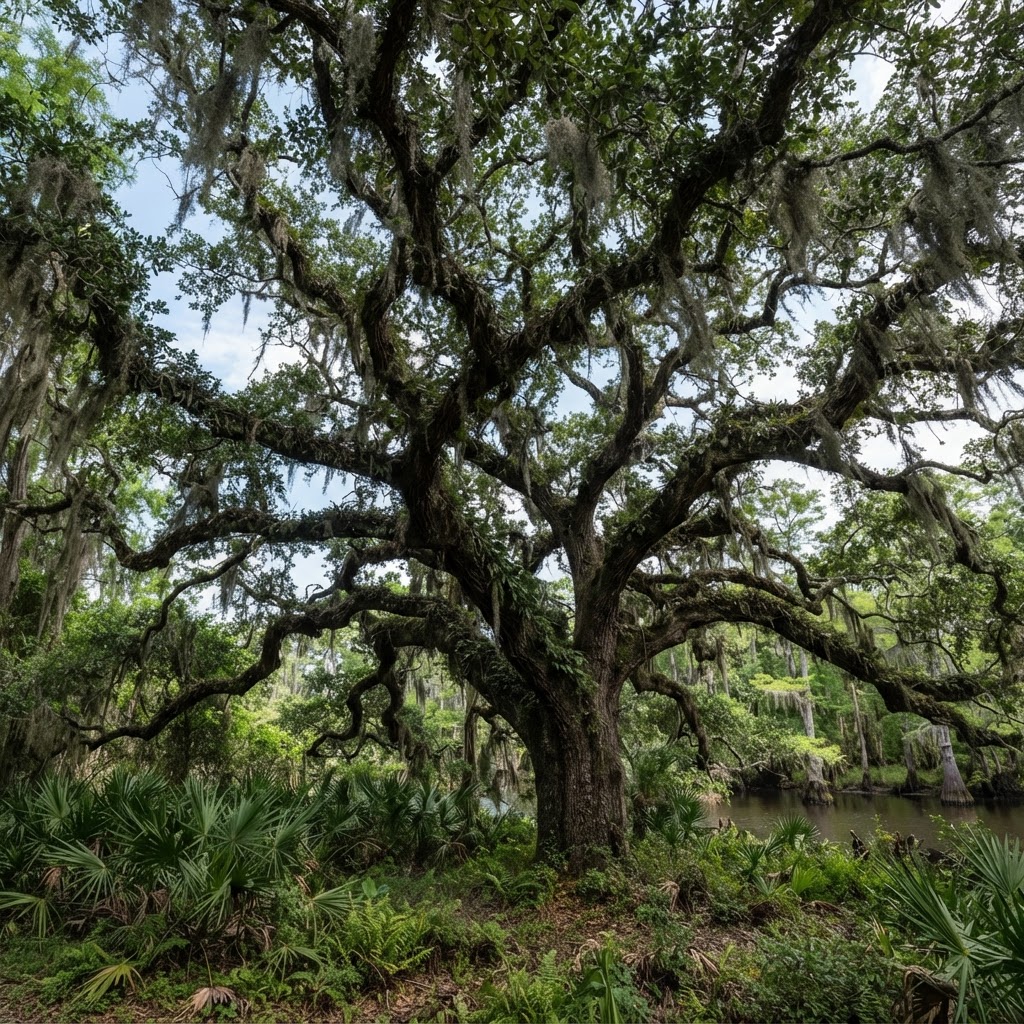
The southern live oak is the tree that gives the Gulf country its look. It is broad more than it is tall, spreading its lower limbs horizontally until they grow longer than the tree is high, so that an old one covers half an acre of ground. The wood is heavy and curved, which is why shipbuilders once wanted it, and the evergreen leaves are small, thick, and dark. In the deeper coastal country the Spanish moss hangs from the limbs in long grey streamers, and under the tree the air stays cool and still even at noon. It is a tree that makes the ground beneath it into a place.
1Cultural and Historical Significance
Native to the coastal plain of the American Southeast — from Virginia through the Gulf states into Texas — the Southern Live Oak (Quercus virginiana) is the defining tree of the Gulf country, inhabiting sandy maritime soils, shell ridges, and the deep loam of river bottoms within reach of salt air. Among the longest-lived broadleaf trees of North America, specimens of three to five centuries are common, and a few are far older. Indigenous coastal nations valued its dense acorns as a staple flour, leaching the bitter tannins in running water before pounding the meal. Spanish and French colonists treasured the wood above nearly all others: its limbs grow in sweeping curved grain that resists shattering, making it the preferred timber for ship ribs and knees through the age of sail. Evolving against salt spray, periodic inundation, and the shear of hurricane winds, Q. virginiana developed an exceptionally dense chemistry of condensed proanthocyanidins, hydrolyzable ellagitannins, and catechins that armor its evergreen leaves and heavy wood against rot, boring insects, and oxidative decay.
Botanical Sexuality
Live oaks are monoecious, bearing both male (staminate) and female (pistillate) flowers on the same tree. The pendulous yellow-green catkins shed wind-borne pollen in early spring as the new foliage emerges.
Reproductive Features
Male flowers appear in slender, drooping catkins; the female flowers are inconspicuous, reddish, and sit at the base of new shoots. Fertilized flowers develop into slender dark acorns, roughly one centimeter long, set in a shallow scaly cup, maturing in a single season and falling through the autumn.
Foliage Identification
Leaves are thick, leathery, and evergreen — narrowly elliptical, one to four inches long, with edges that are usually entire or only faintly rolled under. The upper surface is dark glossy green; the underside is pale and finely downy. The silhouette is unmistakable: a single trunk splitting low into massive horizontal limbs that spread wider than the tree is tall, often draping toward the ground.
Harvesting Implications & Foliar Potency
Spring catkins and young leaves concentrate accessible phenolic glycosides and soluble tannins, making early-season collection ideal for gentle astringent preparations. Late-summer and autumn acorns and inner bark hold the densest concentrations of condensed and hydrolyzable tannins, the primary biological resource for antioxidant, astringent, and tissue-fortifying extracts.
2Chemical Composition and Bioactive Constituents
Southern Live Oak carries a heavy phenolic arsenal typical of a long-lived, decay-resistant oak: condensed proanthocyanidins, hydrolyzable ellagitannins (including tellimagrandin and casuarictin precursors), catechins, and the flavonoids quercetin and kaempferol. The ellagitannins break down in the digestive tract into ellagic acid, and the condensed tannins cross-link structural proteins to tighten tissue.
3Mechanisms of Action and Systemic Physiological Effects
A. Neurological and Central Nervous System Effects
Quercetin and catechin fractions cross the blood-brain barrier to quench reactive oxygen species in hippocampal tissue and suppress microglial activation, dampening neuro-inflammatory NF-κB signaling during sustained stress. Ellagitannin-derived urolithins — produced when colonic microflora metabolize ellagic acid — reach the brain via circulation and support mitochondrial resilience in neural tissue, a pathway increasingly linked to cognitive longevity.
B. Systemic Physiological Effects
Systemically, the ellagitannin and proanthocyanidin fractions reinforce vascular collagen matrices and reduce capillary fragility. Condensed tannins bind mucosal proteins, lending astringent tone to inflamed digestive tissue, while ellagic acid supports hepatic phase-II detoxification pathways. The same tannic cross-linking that protects the tree's wood translates, in the body, to structural reinforcement of vessel walls and connective tissue against glycation and oxidative wear.
C. Extraction and Preparation Profiles
Cold Extraction
(Spring Sap / Cold Maceration)
What Is Gained
Cold maceration of young spring leaves or catkins draws off water-soluble catechins, quercetin glycosides, and trace soluble minerals into a pale, faintly astringent liquor. Unheated, it preserves the delicate phenolic glycosides that gentler tissues tolerate well, supporting mild vascular reinforcement and gentle oral astringency.
What Is Lost
Heavy condensed proanthocyanidins and lipophilic triterpene fractions remain locked inside the dense leaf cell walls and woody tissue. Cold extraction forfeits the deep central neuroprotection, the full hepatic detoxification support, and the oncolytic ellagic-acid pathways that only heat or ethanol can fully liberate.
What Happens to You
Decoction
(Boiling / Heat Maceration)
What Is Gained
Boiling mature leaves, acorn meal, or inner bark ruptures the dense cell walls, liberating heavy hydrolyzable ellagitannins, condensed proanthocyanidins, and free ellagic acid into a dark, strongly astringent decoction. Heat-liberated tannins bind digestive enzymes, flattening post-meal glycemic surges, while ellagic acid supports liver detoxification and vascular collagen integrity.
What Is Lost
Prolonged boiling degrades heat-sensitive catechins and fails to dissolve the non-polar, lipophilic triterpene fractions that reside in the wood. Decoction therefore forfeits peak oncolytic triterpene extraction and the lighter aromatic top-notes of the spring leaf.
What Happens to You
Fermentation with Wild Yeast
(Spontaneous Viticulture & Ethanol Extraction)
What Is Gained
Fermenting crushed leaves, acorns, or bark extracts with wild yeasts (Saccharomyces, Hanseniaspora) generates ethanol, an amphiphilic solvent that dissolves the non-polar triterpene and ellagitannin-derived lipophilic fractions otherwise locked in the dense wood. Microbial enzymes cleave glycosidic bonds, freeing highly bioavailable ellagic acid and urolithin precursors that reach the brain via circulation.
Cancer Destruction & Oncolytic Powers
Extracted via amphiphilic alcoholic fermentation, ellagic acid and ellagitannin-derived metabolites act as multi-targeted agents against malignant cell lines. They induce G₁ cell-cycle arrest by downregulating Cyclin D1, upregulate pro-apoptotic Bax while suppressing Bcl-2 to trigger intrinsic apoptosis via caspase-9 and caspase-3, and inhibit VEGF and matrix metalloproteinases to choke off tumor angiogenesis and metastatic spread. Concurrent suppression of NF-κB chokes the pro-inflammatory cytokine microenvironment (TNF-α, IL-6) that tumors exploit to evade immune surveillance.
What Is Lost
Yeast metabolism converts available sugars into ethanol and carbon dioxide, eliminating the gentle energy and hydration of the cold extract. The fermented liquor is markedly dry, bitter, and tannic, forfeiting the soft spring-leaf palate entirely.
What Happens to You
4Safety, Toxicology, and Precautions
Raw Acorns & Crude Tannin Loads
Avoid consuming unprocessed acorns in bulk. Their heavy condensed-tannin load is intensely astringent and can irritate the gastric mucosa, causing nausea and cramping; traditional practice always leached them first. Even as medicine, high doses of crude inner-bark decoction carry the same mucosal risk.
Inner Bark Resins in Concentration
Refined crude wood extracts concentrate resins and tannins that, in excess, can slow digestion and bind dietary minerals. Keep decoctions moderate and intermittent rather than daily at strength.