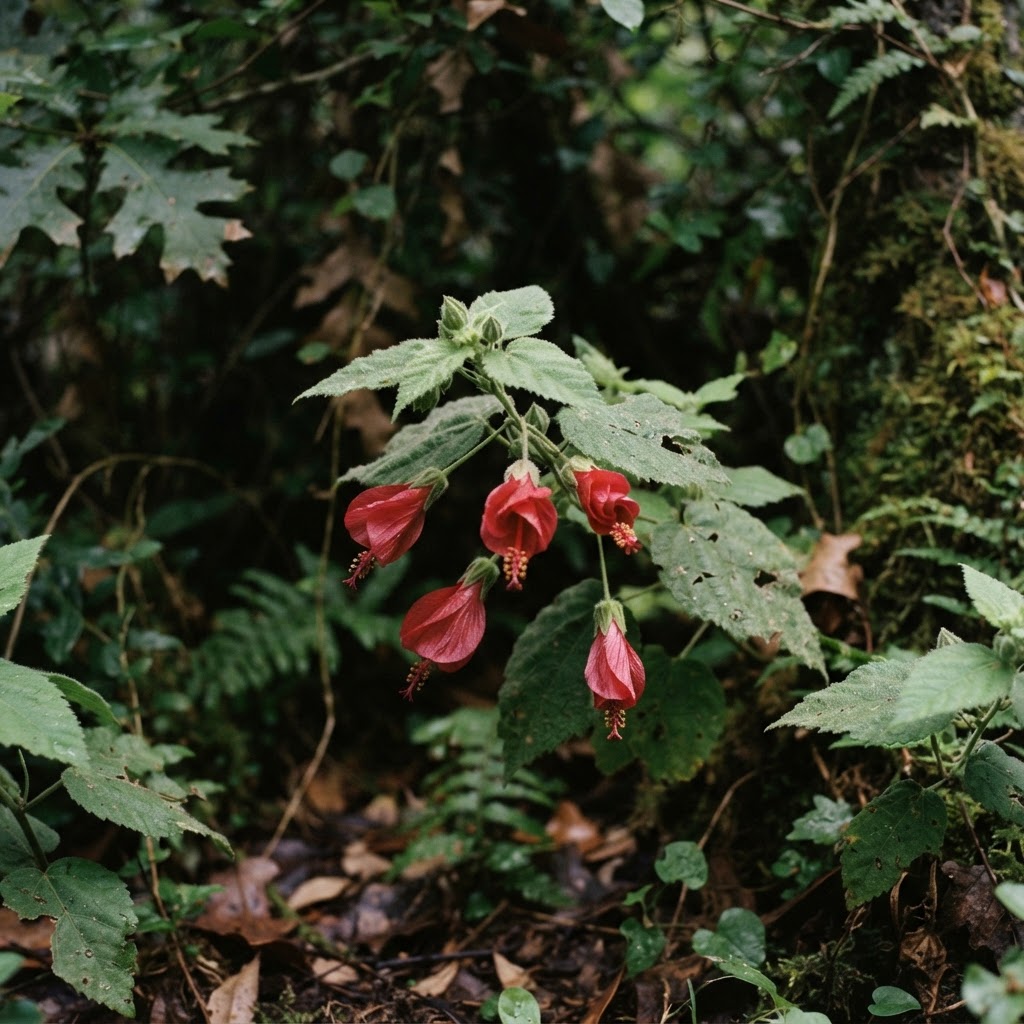
The Turk's cap is a shade-loving shrub of the understory, plain enough for most of the year and then, in the long summer, hung with small red flowers that never quite open — rolled half-shut like a turban, with a single column of stamens thrust out from the fold. The hummingbirds find it before a man does. Its leaves are soft and rough, and the small red fruit that follows the flower is sweet in a quiet way, the kind of thing a child learns to look for and then forgets to mention. It grows in the low woods and along the fence rows where the ground stays damp, and it holds its place without insisting on it.
1Cultural and Historical Significance
Native to the American Gulf Coast and south into Mexico, Turk's Cap (Malvaviscus arboreus var. drummondii) is a shade-loving shrub of the understory and the fencerow, plain enough for most of the year and then, through the long summer, hung with small red flowers that never quite open — rolled half-shut like a turban, with a single column of stamens thrust out from the fold. Indigenous and early colonial peoples of the Gulf ate the sweet fruit and used the mucilaginous leaves and flowers in traditional practice to soothe irritated mucous membranes and the skin. A close cousin of hibiscus and okra, it carries the same soft, demulcent quality. Evolving in the deep shade of humid Gulf woods, M. arboreus developed a chemistry of anthocyanins, flavonoid glycosides, and soft mucilage that protects its tissues and gives the plant its gentle demulcent character.
Botanical Sexuality
Turk's cap is hermaphroditic, bearing perfect (bisexual) flowers — each bloom containing both male and female reproductive parts. The flowers open sequentially through the long summer and are pollinated chiefly by hummingbirds.
Reproductive Features
The flowers are distinctive: small, two-inch scarlet whorls that never fully unfurl, with a projecting column of fused stamens and a long style emerging from the fold. Fertilized flowers develop into small, round, apple-like green fruits that turn bright red when ripe, sweet and faintly mealy, eagerly taken by birds.
Foliage Identification
Leaves are simple, alternate, heart-shaped to broadly lobed, softly hairy, two to four inches long, dark green and slightly rough above. The stems are slender and the shrub grows loosely, often leaning and rooting where it touches the ground. It spreads by seed and by layering into dense, informal thickets.
Harvesting Implications & Foliar Potency
Summer flowers and ripe fruit carry the peak concentration of anthocyanins and flavonoid glycosides. The leaves, available through the growing season, hold the soft mucilage and soluble pectins that give the plant its demulcent character — the primary resource for mucosal preparations.
2Chemical Composition and Bioactive Constituents
Turk's Cap holds a mallow-family chemistry of deep-red anthocyanins (malvidin and cyanidin glycosides), flavonoid glycosides, soluble pectins, and soft plant mucilage — complex polysaccharides that coat and soothe tissue. The anthocyanins carry the plant's antioxidant and dermal-protective weight, while the mucilage provides demulcent action.
3Mechanisms of Action and Systemic Physiological Effects
A. Neurological and Central Nervous System Effects
Concentrated anthocyanins and flavonoid glycosides quiet central neuroinflammation and moderate microglial activation, supporting cerebrovascular circulation without any stimulant effect. The anthocyanins reach the brain via circulation to reinforce neural antioxidant defenses.
B. Systemic Physiological Effects
Systemically, the leaves and flowers yield soft mucilage and soluble pectins that coat and soothe gastric mucosa, easing irritation. The deep-pigmented fruit provides exceptional antioxidant capacity against lipid peroxidation and defends dermal tissue against UV damage through its anthocyanin and flavonoid fractions.
C. Extraction and Preparation Profiles
Cold Extraction
(Spring Sap / Cold Maceration)
What Is Gained
Cold maceration of flowers, fruit, or leaves draws off water-soluble anthocyanins, flavonoid glycosides, soluble pectins, and soft mucilage into a brilliant, sweet, magenta liquor. Unheated, it preserves the heat-sensitive anthocyanins and the demulcent mucilage, supporting gentle mucosal soothing and dermal antioxidant protection.
What Is Lost
Lipophilic flavonoid aglycones remain locked in the leaf and flower tissue. Cold extraction forfeits deep central neuroprotection and any oncolytic anthocyanin pathways that require ethanol.
What Happens to You
Decoction
(Boiling / Heat Maceration)
What Is Gained
Boiling leaves, flowers, or fruit ruptures the cells, liberating the full mucilage, soluble pectins, and a portion of the anthocyanins into a warm, soft, demulcent decoction. Heat releases the demulcent polysaccharides that coat and soothe gastric mucosa, while the warm liquid supports respiratory mucosa through inhalation.
What Is Lost
Prolonged boiling degrades a significant portion of the heat-sensitive anthocyanins and fails to dissolve the non-polar flavonoid aglycones. Decoction therefore forfeits peak antioxidant depth and the deepest oncolytic anthocyanin extraction.
What Happens to You
Fermentation with Wild Yeast
(Spontaneous Viticulture & Ethanol Extraction)
What Is Gained
Fermenting fruit, flower, or leaf extracts with wild yeasts generates ethanol, which dissolves the non-polar flavonoid aglycones and lipophilic anthocyanin derivatives that water cannot reach. Microbial enzymes cleave glycosidic bonds, freeing maximally bioavailable anthocyanin and flavonoid aglycones that cross the blood-brain barrier to engage the plant's defining central and oncolytic signaling.
Cancer Destruction & Oncolytic Powers
Extracted via amphiphilic alcoholic fermentation, anthocyanin and flavonoid aglycones (malvidin, cyanidin, quercetin) act as multi-targeted agents against malignant cell lines. They induce G₁ cell-cycle arrest by downregulating Cyclin D1 and CDK4, shift the Bax/Bcl-2 balance toward intrinsic apoptosis via caspase-9 and caspase-3, inhibit VEGF and matrix metalloproteinases to suppress angiogenesis and metastasis, and suppress NF-κB to strip away the pro-inflammatory cytokine microenvironment (TNF-α, IL-6) tumors exploit.
What Is Lost
Yeast metabolism converts the fruit's natural sugars into ethanol and carbon dioxide, eliminating the bright sweetness. The fermented liquor is dry, tart, and slightly bitter, forfeiting the soft, dessert-like palate of the ripe fruit.
What Happens to You
4Safety, Toxicology, and Precautions
Minimal Toxicity
Turk's cap is among the gentler Gulf plants, with no significant toxicity recorded; the ripe fruit and leaves are widely eaten. The only caution is that the soft mucilage can mildly slow digestion when taken in very large quantity on an empty stomach.