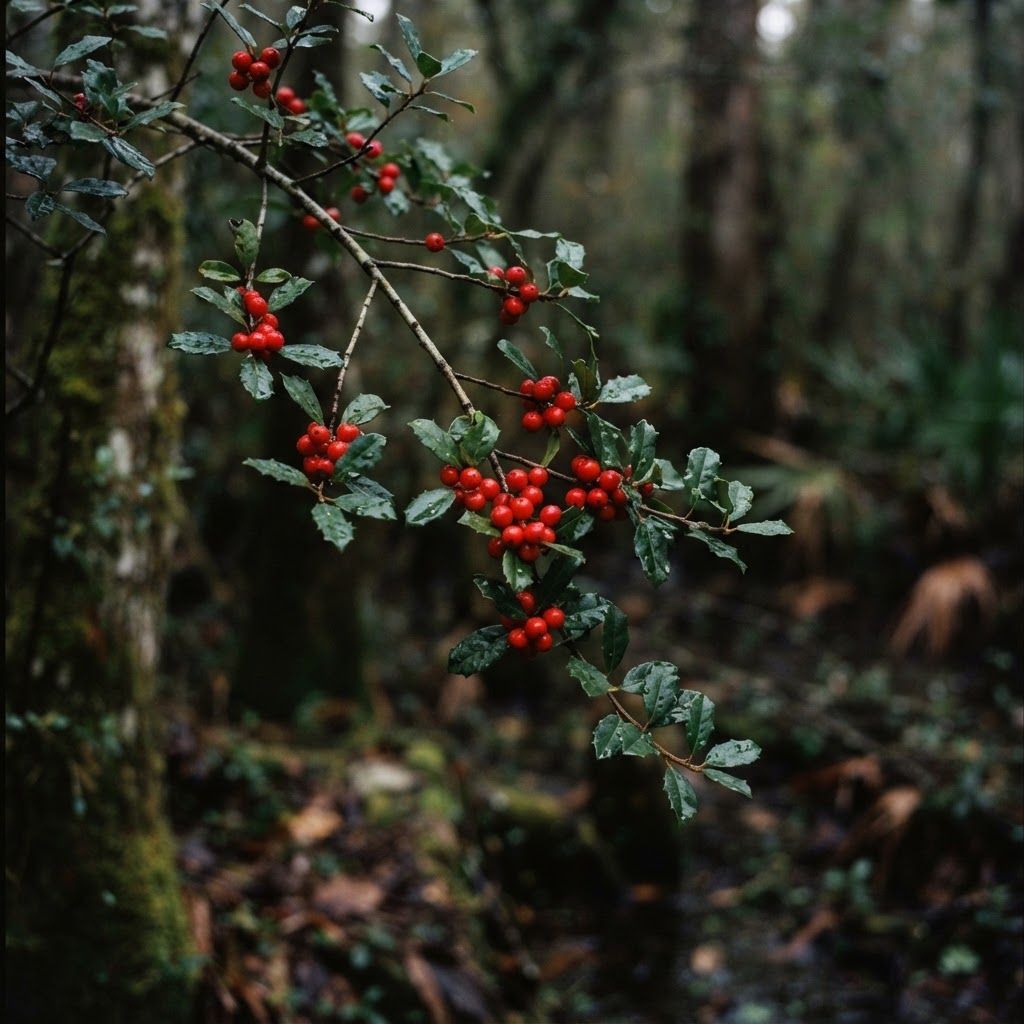
The yaupon is the holly of the coastal thickets, its small red berries bright against the dark, glossy leaves through the winter. What most people do not know is that its leaves carry caffeine — the only native plant of North America that does — and the early people along the Gulf roasted and brewed them into a black drink they called by a name the colonists mistranslated as a word for vomiting, though the plant does nothing of the sort. It grows in the low woods and on the shell ridges, dense and evergreen, and in the early spring the air above a stand of it hums with bees. It is a common thing, overlooked, and it carries a kind of quiet wealth.
1Cultural and Historical Significance
Native to the coastal plain of the American Southeast from Virginia through the Gulf states into Texas, Yaupon Holly (Ilex vomitoria) is the evergreen holly of the coastal thickets and the shell ridges, its small red berries bright against the dark, glossy leaves through the winter. What most people do not know is that its leaves carry caffeine — the only native plant of North America that does. Indigenous nations of the Gulf and Southeast roasted and brewed the leaves into a potent black drink used in ceremony and counsel, and, in purification rites, consumed in large quantity to induce ritual vomiting — the practice that led early European observers, misunderstanding the cause, to give the species its unfortunate scientific name. Evolving on dry, sandy, salt-swept ground, I. vomitoria developed a methylxanthine and phenolic-acid chemistry — caffeine, theobromine, chlorogenic acid, and rutin — that defends its evergreen foliage against herbivory and oxidative stress.
Botanical Sexuality
Yaupon is dioecious, with male and female flowers on separate shrubs. Only the female plants bear the bright red berries that distinguish the species through winter.
Reproductive Features
The small, white, four-petaled flowers appear in spring in clusters along the branches. On female plants, fertilized flowers develop into small, round, bright-red drupes that persist through winter, each holding several ribbed seeds. The berries are mildly toxic to humans but eagerly taken by birds.
Foliage Identification
Leaves are small, alternate, evergreen, oval, one to two inches long, with rounded teeth and a sharp spine at the tip — less fiercely armed than other hollies. The upper surface is glossy dark green, the underside paler and dull. The shrub is dense, multi-stemmed, and evergreen, forming thickets on the coastal ridges and shell middens.
Harvesting Implications & Foliar Potency
Spring and early-summer leaves hold the peak concentration of caffeine, theobromine, and chlorogenic acid — the primary resource for the stimulating and neurologically active extracts. Late-autumn leaves carry the densest rutin and phenolic-acid fractions for vascular preparations. The berries are not used medicinally.
2Chemical Composition and Bioactive Constituents
Yaupon Holly holds a methylxanthine chemistry unique among North American natives: caffeine and theobromine, alongside chlorogenic acid, rutin, and quercetin glycosides. The methylxanthines stimulate the central nervous system, while chlorogenic acid and rutin support vascular and metabolic function.
3Mechanisms of Action and Systemic Physiological Effects
A. Neurological and Central Nervous System Effects
Caffeine and theobromine act as adenosine-receptor antagonists, sustaining mental focus, working memory, and alertness through a slow, even release — without the spike-and-fall of roasted coffee. Chlorogenic acid supports cerebrovascular circulation, and the methylxanthines enhance dopamine and acetylcholine signaling acutely.
B. Systemic Physiological Effects
Systemically, chlorogenic acid and rutin support endothelial function, gently downregulate systemic inflammatory markers, and reinforce capillary integrity. The methylxanthines modestly relax smooth muscle and support renal filtration, while chlorogenic acid supports hepatic glucose regulation.
C. Extraction and Preparation Profiles
Cold Extraction
(Spring Sap / Cold Maceration)
What Is Gained
Cold maceration of lightly bruised fresh leaves draws off water-soluble caffeine, theobromine, chlorogenic acid, and rutin into a pale, faintly green, gently stimulating liquor. Unheated, it preserves the heat-sensitive aromatics and delivers a smooth, low-acid lift in focus and alertness.
What Is Lost
Lipophilic flavonoid aglycones and volatile aromatic top-notes remain locked in the leaf. Cold extraction forfeits the deeper vascular reinforcement and any oncolytic chlorogenic-acid pathways that ethanol would free.
What Happens to You
Decoction
(Boiling / Heat Maceration)
What Is Gained
Boiling roasted leaves (the traditional 'black drink') fully extracts caffeine, theobromine, chlorogenic acid, and rutin into a dark, robust, tea-like decoction. Heat-liberated rutin reinforces capillary walls, and the warm aromatic vapor supports respiratory and autonomic tone.
What Is Lost
Prolonged boiling degrades a portion of the delicate aromatics and fails to dissolve the non-polar flavonoid aglycones. Decoction therefore forfeits peak oncolytic chlorogenic-acid extraction and the light vegetal top-notes of the cold extract.
What Happens to You
Fermentation with Wild Yeast
(Spontaneous Viticulture & Ethanol Extraction)
What Is Gained
Fermenting leaf extracts with wild yeasts generates ethanol, which dissolves the non-polar flavonoid aglycones and lipophilic chlorogenic-acid derivatives that water cannot reach. Microbial enzymes cleave glycosidic bonds, freeing maximally bioavailable quercetin and chlorogenic-acid aglycones that cross the blood-brain barrier to engage the plant's defining central and oncolytic signaling, alongside the stimulating methylxanthines.
Cancer Destruction & Oncolytic Powers
Extracted via amphiphilic alcoholic fermentation, chlorogenic-acid derivatives and quercetin aglycones act as multi-targeted agents against malignant cell lines. They induce G₁ cell-cycle arrest by downregulating Cyclin D1 and CDK4, shift the Bax/Bcl-2 balance toward intrinsic apoptosis via caspase-9 and caspase-3, inhibit VEGF and matrix metalloproteinases to suppress angiogenesis and metastasis, and suppress NF-κB to strip away the pro-inflammatory cytokine microenvironment (TNF-α, IL-6) tumors exploit.
What Is Lost
Yeast metabolism consumes available sugars into ethanol and carbon dioxide. The fermented liquor is dry, bitter, and astringent, and its caffeine edge is softened by the alcohol — forfeiting the bright, clean lift of the traditional decoction.
What Happens to You
4Safety, Toxicology, and Precautions
The Berries
The bright red drupes are mildly toxic — they can cause nausea, vomiting, and diarrhea if eaten in quantity. Only the roasted leaves are used as the stimulating brew; the berries should be left for the birds.
Caffeine Sensitivity
The leaves carry genuine caffeine in concentration comparable to tea. Those sensitive to caffeine, or taking stimulant medications, should approach concentrated preparations with the same caution they would coffee or strong tea.